
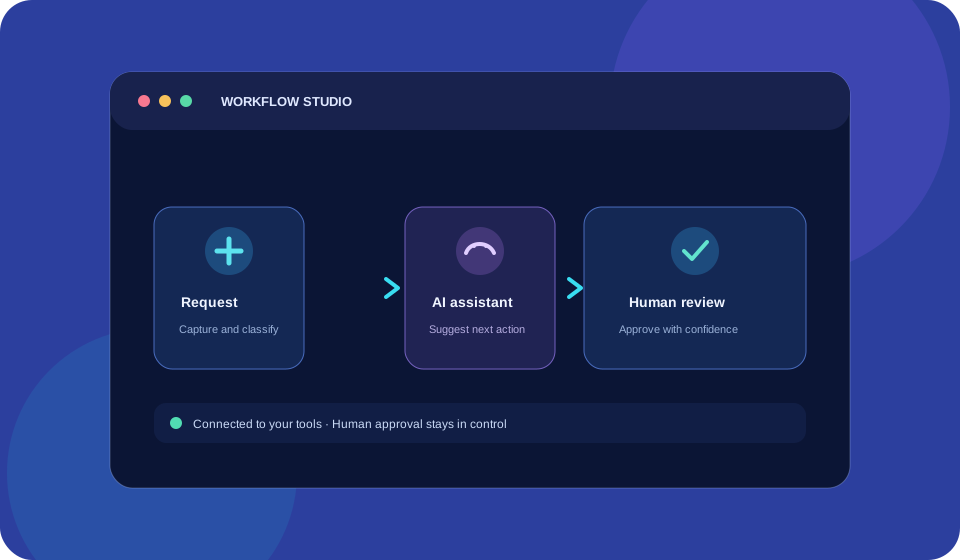
Choose a bounded task
Start with a specific workflow that has clear inputs and an observable outcome. Summarization, document triage and first-draft assistance are easier to evaluate than open-ended automation across an entire department.
Keep the system connected to approved sources and give it only the tools needed for that task. Narrow scope improves clarity and makes failures easier to understand.
Keep people in the decision loop
Automation should make a person’s work easier without hiding uncertainty. Show relevant source material, make generated actions reviewable and provide an easy route to pause or escalate the workflow.
Sensitive operations should require explicit approval. The right level of oversight depends on the potential impact of a mistaken output.
Measure quality before expanding
Create representative examples and review the system against them before launch. Track correctness, completion time, escalation rates and the cases where the model should decline to act.
Use those findings to improve prompts, data access and product controls. Expand only when the workflow is predictable enough for the intended users.